
BeBackup, a modular solution
BeBackup adapts to your environment, your volumes and your hosting strategy.
Which architectures are possible?
The architecture follows from your initial choice.
- Do you want to host your own data and/or your clients' data yourself?
- Would you rather have access to a dedicated server, hosted and administered by us?
- Or a mix of the two?
- Do you want to keep a local copy of the backups at your clients' premises?
- Finally, which data do you want to back up?
One thing is certain: BeBackup adapts to all your needs and all your constraints. Words are hard work? Here is a diagram instead.
A typical BeBackup infrastructure
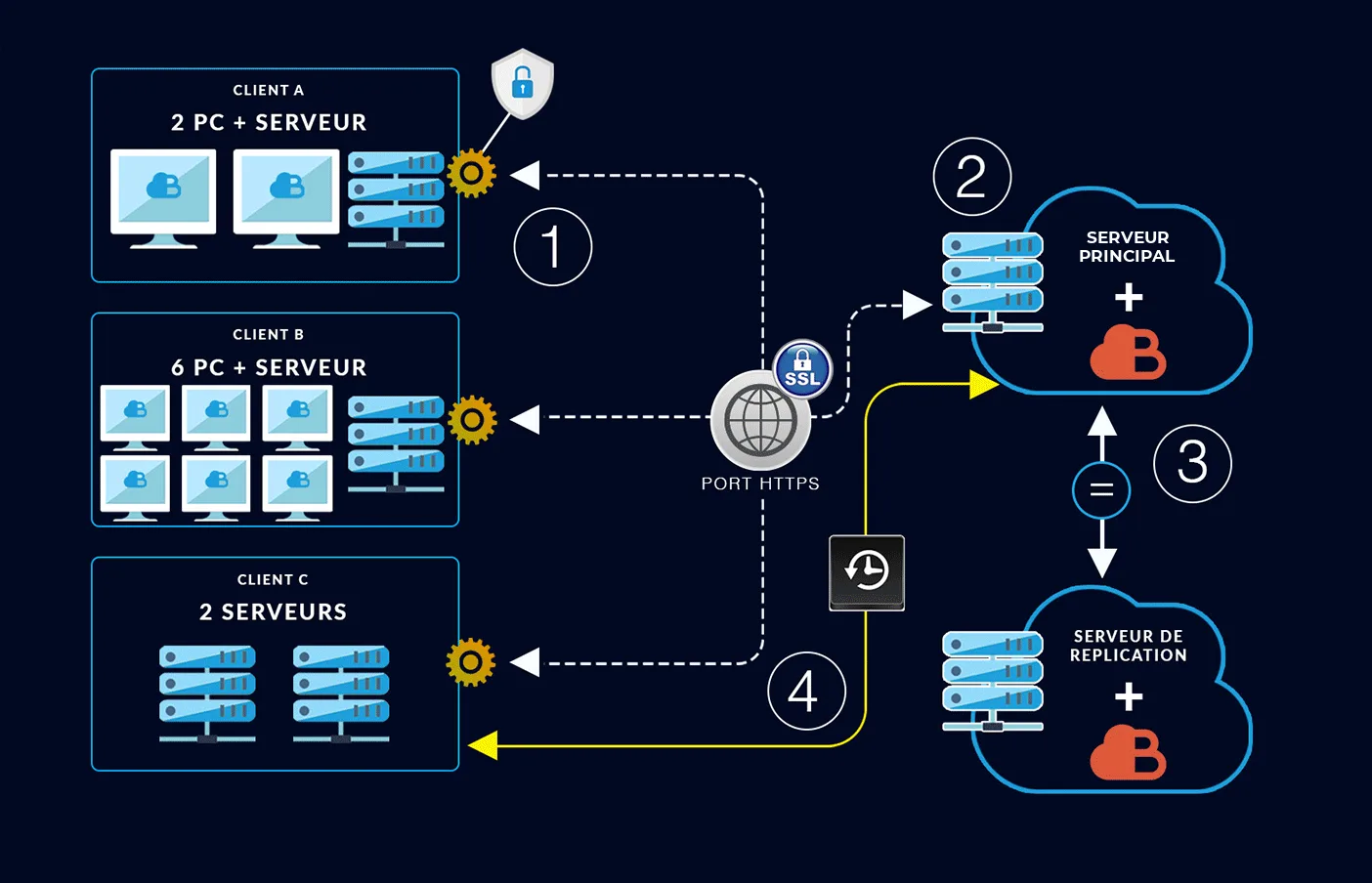
-
1
You back up your clients' computers and servers.
-
2
Backups are made to the main BeBackup server.
-
3
They can be replicated to one or more secondary servers.
-
4
If needed, your clients restore their data entirely on their own.
Where the data lives, if you choose BeBackup Cloud
Hosting it yourself remains possible, and that is what providers handling large volumes do. For everyone else, our hosting offering runs on an infrastructure we operate ourselves, in France.
- Three copies, three servers: the backup arrives on a primary server, which replicates it to two secondary servers.
- Three distinct sites: two data centres, in Tours and in Grenoble, and our own premises. Not the same power supply, not the same network, not the same building.
- Servers that belong to us: we do not rent storage from a third party to resell it. The hardware is ours, and we administer it.
- Encrypted at source, before they arrive: replication moves blocks we cannot read. Three copies do not mean three opportunities for a leak.
- Facilities described: redundant power chains on UPS, a diesel generator, fire detection and suppression, redundant cooling, controlled access, permanent monitoring, multi-operator networks.
- Certifications credited to those who hold them: the Tours data centre, operated by Castle-IT, is certified ISO/IEC 27001:2022 and HDS v2.0 (certificates published by Castle-IT). The Grenoble site, operated by Cogent, claims no certification. These certifications belong to the data centre operator, not to EDII: EDII is not itself HDS-certified and therefore does not host health data on that basis.
This infrastructure belongs to EDII, the publisher of BeBackup: the same data centres and the same team also run its cloud hosting offer.
This is what lets you answer precisely when a client asks where their data is, or when an invitation to tender requires the sites to be named. See the encryption in detail
Backup frequency and retention period
- Up to two backups an hour, set medium by medium according to how much each client can afford to lose.
- 90 days of history by default: this is the setting offered when a medium is created.
- No upper time limit: history can be kept for as long as needed, months or decades.
- A purge that thins out instead of erasing (new in version 7): tiered retention keeps, for example, one backup a day for a month, one a month for a year, then a single one a year for thirty years. A simulation shows what would be kept or deleted, and why, before the rule is applied.
Contact the BeBackup team
Would you like to know more about our BeBackup backup solution?